ServicesUV Water Purification
UV Water Purification in Uhland
A UV system treats every gallon entering your home with ultraviolet light, neutralizing 99.9% of bacteria with no chemicals and just one lamp change a year. It leaves the taste unchanged. We test your water first, then install with photos at each step so you can see what we did.
What UV purification does, and what it doesn't
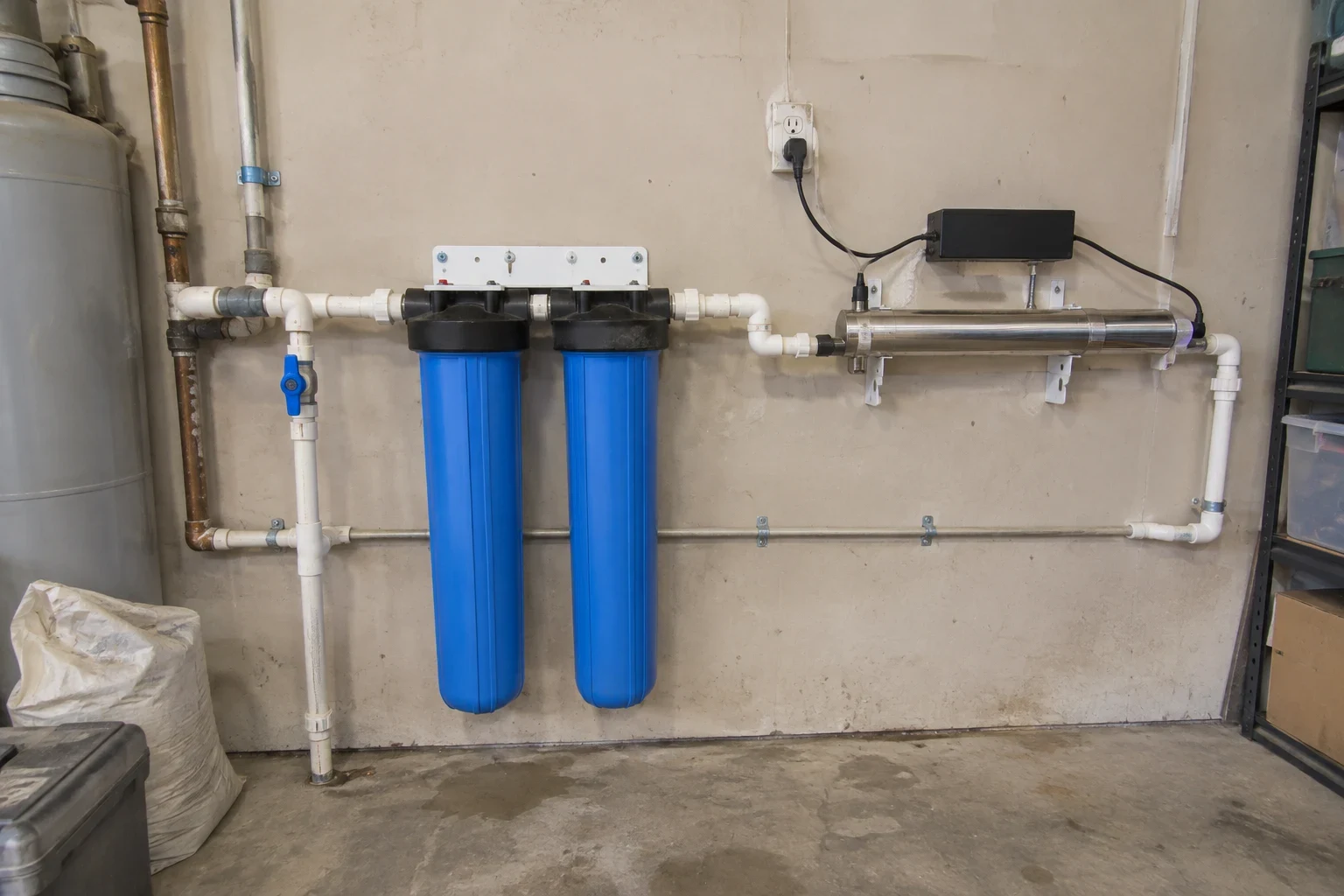
Inside a UV system, water travels through a stainless steel chamber around a single lamp. A clear quartz sleeve surrounds the lamp, keeping it dry while letting the light through. That UV-C light, at a wavelength of 254 nanometers, neutralizes 99.9% of bacteria with no chemicals, and the lamp needs changing just once a year. Your water gains nothing and loses nothing on the way through.
That is also where its job ends. UV leaves chlorine, lead, hardness, iron and sediment exactly as they were. Think of it as the final checkpoint for microorganisms, one that performs best when the water arriving at the chamber is already clear. So we often place it after whole-home filtration or at least a sediment stage.
It is a sensible choice for a home whose water source is untreated or uncertain, for families who want a backstop after boil-water notices, and for anyone whose lab report shows coliform bacteria. When your test shows no microbial concern, we tell you so plainly.
What our UV installation includes
- A water test before anything is sized
- We measure clarity, iron, hardness and UV transmittance. Together they tell us whether the light can reach every microbe in the chamber and whether pre-treatment belongs in the plan.
- A chamber sized to your real flow
- Sizing follows your peak gallons per minute, for example two showers and the washing machine at once. An undersized chamber lets water race past the lamp before it receives a full dose.
- Pre-filtration for sediment
- A 5-micron cartridge upstream traps fine particles that could otherwise shelter microbes from the light. It also slows the film that collects on the quartz sleeve between cleanings.
- Placement on the main line
- The unit sits after any softener or filter and ahead of the first branch in your home. We give it a dedicated outlet and leave clearance so the lamp can be pulled out for service.
- Disinfecting the lines after install
- UV guards the water flowing through the chamber from installation onward. It cannot reach bacteria that have already settled in existing plumbing, so once the system is running we disinfect the lines beyond it.
- A visual record of the job
- We photograph the existing plumbing, the new connections, the electrical setup and the finished install, and the set is yours to keep. It is useful if you sell your home or bring in someone else for service later.
Signs a UV system may be right for your home
Coliform in a lab result
A positive coliform or E. coli result is the clearest reason to consider UV. We confirm it with a retest and then look for the source.
Repeated boil-water notices
If notices have left you boiling water more than once, UV gives your home its own line of defense at the point of entry.
An untreated or unknown source
Water that has never been disinfected, or a source you can't account for, is worth testing. UV is the usual answer when bacteria turn up.
Someone vulnerable in the house
A newborn, an aging parent or a family member whose immune system is under strain may react more strongly to waterborne germs. Some families add UV as a quiet extra layer for that reason alone.
An older UV unit that's been ignored
A lamp past its rated hours can still glow while giving off too little UV-C to do its job. A fogged sleeve has the same effect. If no one remembers the last lamp change, it's time to check.
What shapes the cost of UV purification
Your water and your plumbing move the price far more than the UV unit itself does. Because we offer free installation, the quote is built around the equipment your test calls for. Every part sits on its own line of the estimate rather than being folded into a single total.
Peak flow
Each added bathroom and fixture raises demand at your busiest moment. Higher demand needs a larger chamber and a more powerful lamp.
Pre-treatment needs
Clear water may need nothing more than a sediment filter. Iron, hardness or tannins can coat the quartz sleeve, and they may call for iron and sulfur removal or a softener ahead of the UV unit.
Monitoring and shutoff options
An entry-level controller simply counts down lamp hours. Moving up, you can add a sensor that reads light intensity inside the chamber, or a valve that closes on its own if the lamp stops working.
Access and electrical
A cramped mechanical space, or no outlet close to the main line, means extra labor and parts on install day.
How a UV install day goes
- 1
Test and plan
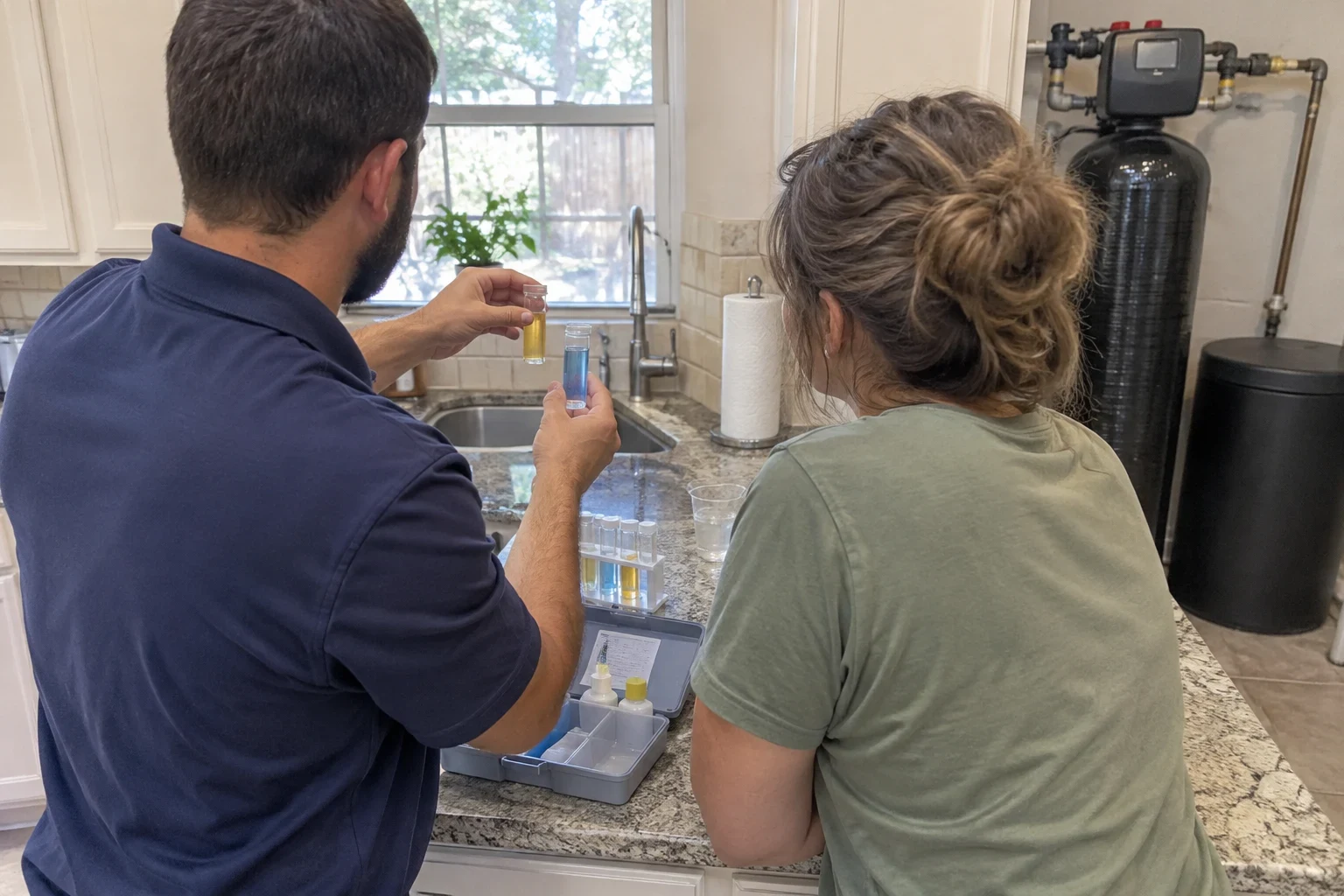
We start with your free water test and walk you through the results. You get your quote by phone with the system size, any pre-filtration and the reasons for each.
- 2
Document and prepare
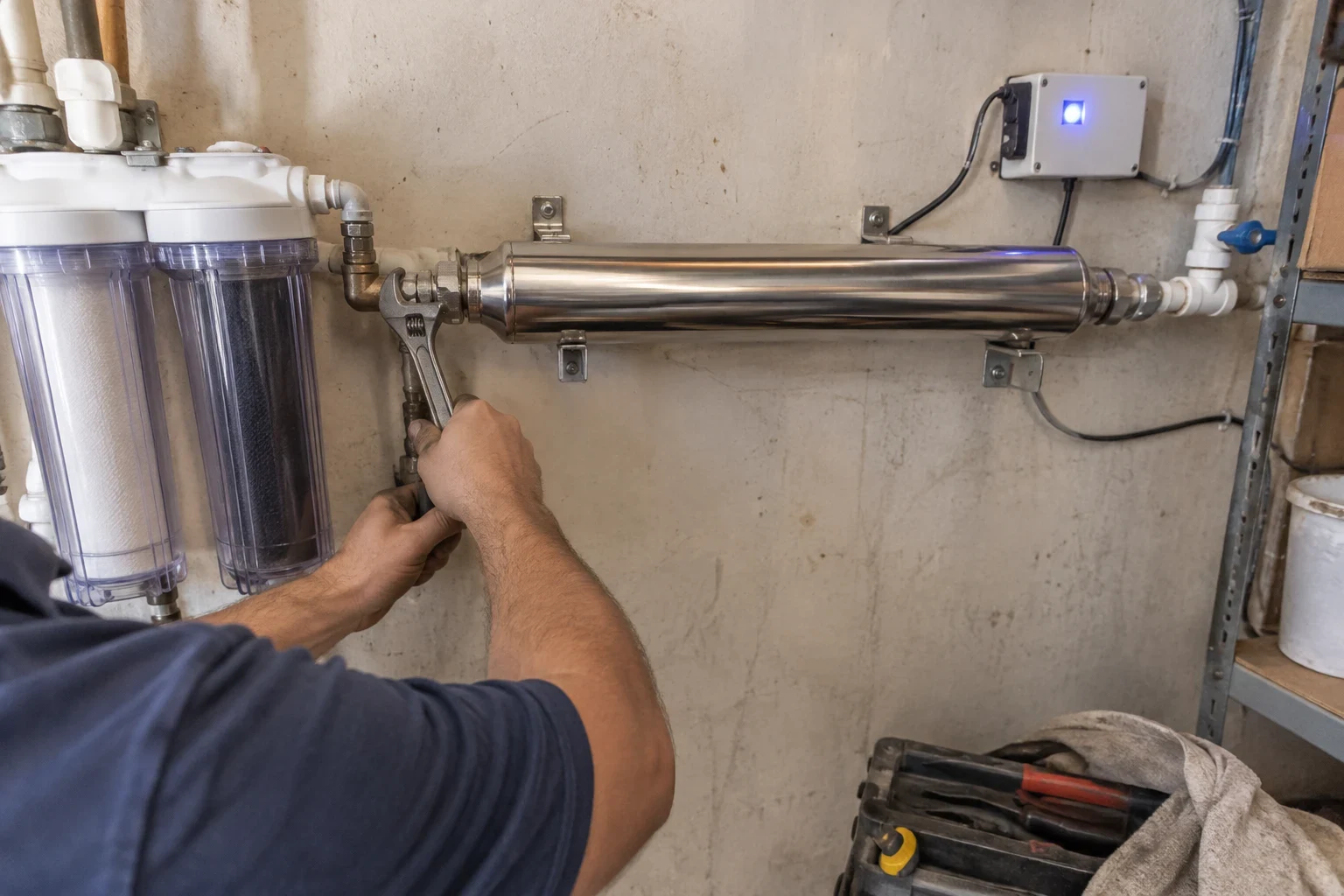
On install day we record the main line and the area around it with pictures before touching anything. Then we lay down floor protection and shut off the water.
- 3
Install and connect
We fit the sediment housing and the UV chamber with unions so either can be removed later. We set the lamp and sleeve, plug the controller into a dedicated outlet and confirm the alarm works. Most homes are without water for a few hours.
- 4
Sanitize, flush and walk through
We sanitize the downstream lines and flush every fixture. On the way out, we point to the counter that tracks remaining lamp hours and explain what each alarm signal is telling you. The work area is left clean, and the images from each stage come to you afterward.
UV purification questions
Will UV change how my water tastes or smells?
No. The light passes through without adding anything or removing anything, so the water at your tap tastes and smells exactly as it does now. If chlorine taste is what bothers you, whole-home filtration or a reverse osmosis system addresses it, and either one works alongside UV.
When should the UV lamp be changed?
Plan on a fresh lamp about once a year, since that is roughly how long most are rated to run without a break. An aging lamp still lights up, but its UV-C output falls below what the chamber was designed around. We clean the quartz sleeve during that same visit.
Does the lamp stay on all the time?
Yes. It runs around the clock so it is already at full strength the moment a faucet opens. Its power draw is similar to a single household light bulb.
What happens if the power goes out?
Any water that moves through while the lamp is dark goes untreated. When power comes back, we suggest running your taps for a few minutes. Units fitted with an automatic shutoff valve hold the water back until the lamp is lit again, which some families prefer.
Can UV handle cloudy or rusty water on its own?
Not dependably. Suspended particles and iron shade microbes from the light and leave a film on the sleeve. This is why we measure UV transmittance before sizing and add pre-filtration when the results point to it.
Find out whether UV belongs on your line
We'll test your water at no charge and give you a straight answer about whether UV fits. Homeowners in Uhland, Kyle, Buda and Lockhart get the same careful, documented install.