ServicesReverse Osmosis Systems
Reverse Osmosis Systems in Uhland
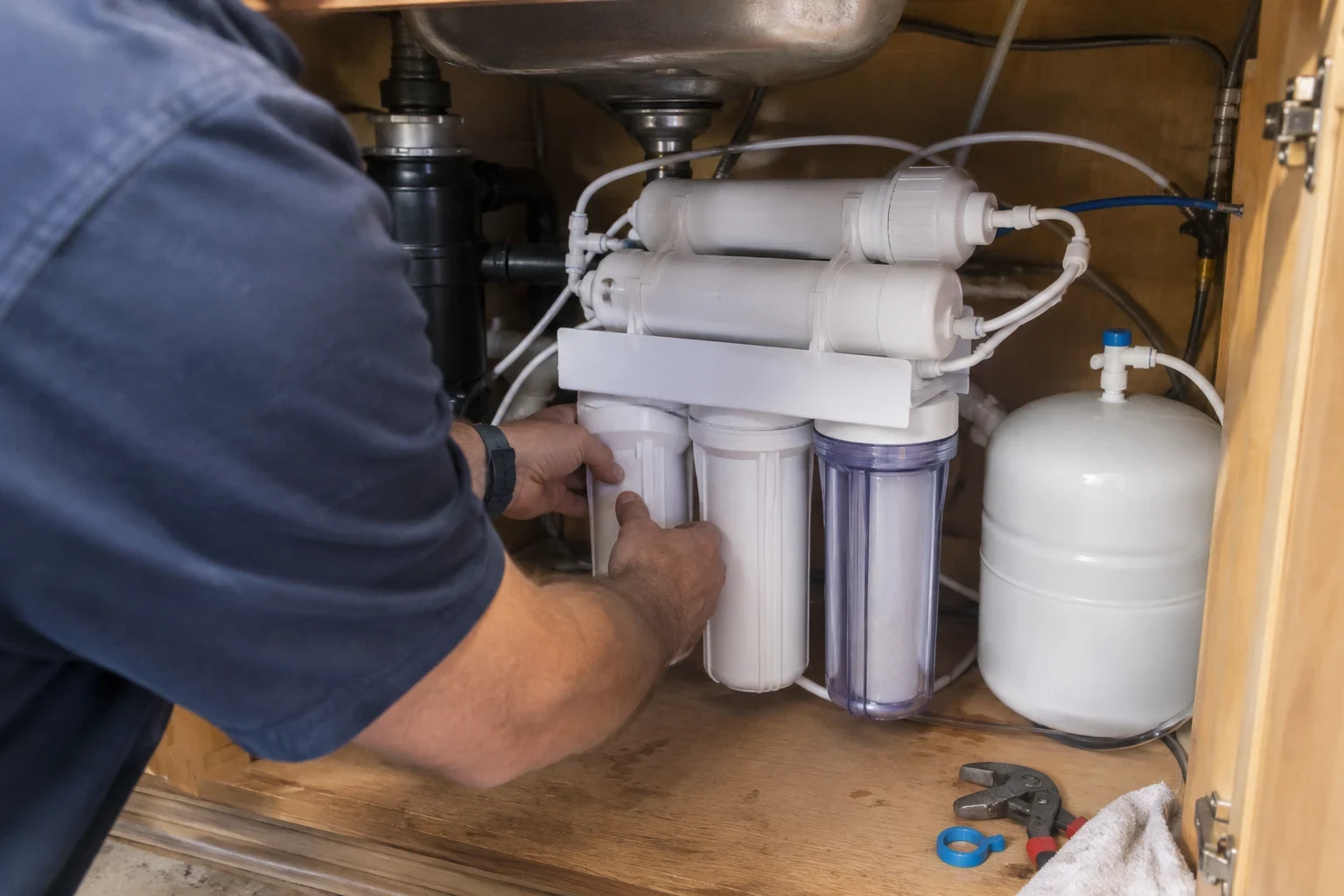
We install under-sink reverse osmosis that turns one kitchen tap into your source of clean, clear drinking and cooking water. We test first, fit the system with care, and photograph each step so you can see exactly what went under your sink.
Clean drinking water from one dedicated tap
A reverse osmosis system sends water across a tightly woven membrane, and only water molecules make it through. Dissolved minerals, salts, many metals and the lingering chlorine taste that a carbon filter on its own may leave behind are rinsed away to the drain. What reaches your glass is the water you drink, cook with and fill the kettle from. The rest of your home stays on its usual supply, which is why reverse osmosis sits at the sink and not at the main line.
This system earns its place when the worry is the glass in your hand. Think of a flat or chemical taste, scale building up in the kettle, doubts about older plumbing, or a pantry stacked with bottled water. If the larger problem runs through the whole house, such as spotty showers or crust on fixtures, we will say so and talk through whole-home filtration or a salt-free water conditioner instead.
We start with a test so the system matches your water. Then we record the cabinet before we touch it, each connection as it is made, and the finished install, and the photos are yours to keep. The next person who services the system knows exactly what is there.
What your installation includes
A test before we recommend anything
We measure total dissolved solids, hardness and chlorine at your kitchen tap. Those numbers decide the stages, the prefilters and whether the membrane needs protection from hard water.
Staged filtration, sized to your water
A typical system runs a sediment prefilter, a carbon prefilter, the membrane and a carbon polishing filter. Where water is mineral-heavy, as it often is across Central Texas, we may add pretreatment so the membrane lasts longer.
A dedicated faucet in the finish you choose
We fit a separate drinking water faucet in a finish that suits your kitchen, using the existing sprayer hole or a clean new opening. On stone counters we use the proper diamond bit and take our time.
Tidy drain and air gap connections
The drain saddle and line are set so they cannot siphon back, and tubing is routed and clipped away from the disposal and the cabinet door. Every joint is checked before the cabinet is reloaded.
Optional lines to the fridge or ice maker
If you want filtered water at the refrigerator, we run a separate line so your ice is clear and tastes like the water from the tap.
A before and after reading
We show you the dissolved solids reading from the regular tap and the new faucet side by side, so the difference is measured, not just tasted.
Signs a reverse osmosis system makes sense
You buy bottled water every week
If the household has stopped drinking from the tap, an RO faucet usually replaces those cases with better water and no plastic to haul.
Coffee and tea taste off
A chlorine edge or a mineral bite comes through in anything you brew. RO removes most of what causes it.
White crust in the kettle
Scale on a kettle or coffee maker means dissolved minerals. A test tells us how much, and RO takes them out of the water you heat.
Older plumbing in the walls
If your home has older pipes or fittings, metals can reach the tap even when the supply itself is fine. RO is a strong second line for drinking water.
Cloudy ice cubes
Cloudy or chalky ice often points to minerals and dissolved gases. Filtered water at the ice maker usually clears it up.
How the work runs on the day
- 1
Test and plan
We test your water, look under the sink and agree on the faucet location, tank position and any refrigerator line. You get a clear quote before work begins.
- 2
Protect and photograph
We lay down a mat, clear and photograph the cabinet as we found it, and note anything worth knowing, such as a weeping shutoff valve.
- 3
Install and connect
We fit the feed valve, drain saddle, faucet, tank and filter housings, recording each connection as it goes in. Most installs take a few hours, with the water off only briefly.
- 4
Final checks and handover
Fresh filters are rinsed until the water runs clear, and we go over each fitting by hand and eye for any drip. You see the before and after reading, learn how a filter change works, and we leave the cabinet clean with your images sent over.
What moves the price of an RO system
The price comes from the system you choose and the kitchen it goes into, not from a fixed formula. We confirm those details during the water test and give you a written quote by phone, so you know the figure before any work starts. We also offer free installation.
- Tank, tankless or remineralizing
- We install two options. The lower-priced choice is a 5-stage tank system under the sink: sediment, GAC, carbon block, RO membrane and post carbon. The tankless system uses 7 stages, filters down to 0.0001 micron and produces 800 gallons per day.
- Countertop material
- Using an existing hole is simple. Drilling quartz, granite or porcelain takes more time and the right tooling.
- Cabinet space and plumbing
- A crowded cabinet with a disposal, or an old shutoff valve that needs replacing, adds work. We show you anything like that and talk it over before going ahead.
- Extra lines and pretreatment
- A run to the refrigerator, or pretreatment to protect the membrane from hard water, adds parts and labor.
Reverse osmosis questions we hear often
Something not covered here? (512) 598-5861
How much water goes down the drain with RO?
Some water always leaves through the drain line, because that rinse is what keeps the membrane clear. Current units are far more efficient than older designs, and adding a permeate pump narrows the ratio further. Since the system only feeds the drinking faucet, most households see little change on the water bill.
Will the water taste flat without minerals?
Some people notice a lighter, cleaner taste, and most come to prefer it. If you want a little mineral character back, we can add a remineralization stage after the membrane.
How often do the filters need changing?
Prefilters are usually changed about once or twice a year, and the membrane every few years, depending on your water and how much you use. We show you how to do it and mark the install date on each housing so you know when the next change is due.
Is there room for RO if my sink already has a disposal?
Usually there is. We tuck the storage tank to one side of the disposal or toward the back wall, and where space is really tight, a slimmer tankless unit is a good answer. We measure the cabinet and look at the layout while we are there for the free water test.
Do I need a softener too?
Not always. If your test shows high hardness, softening or conditioning ahead of the RO protects the membrane and helps the rest of your home. We give you the honest answer from the numbers, and our water softener installation page explains that option.
See what is in your drinking water
We will test your water at the kitchen tap, show you the reading, and give you a straightforward quote for the system that fits. If you go ahead, you will have photos of every step.